La storia – the story
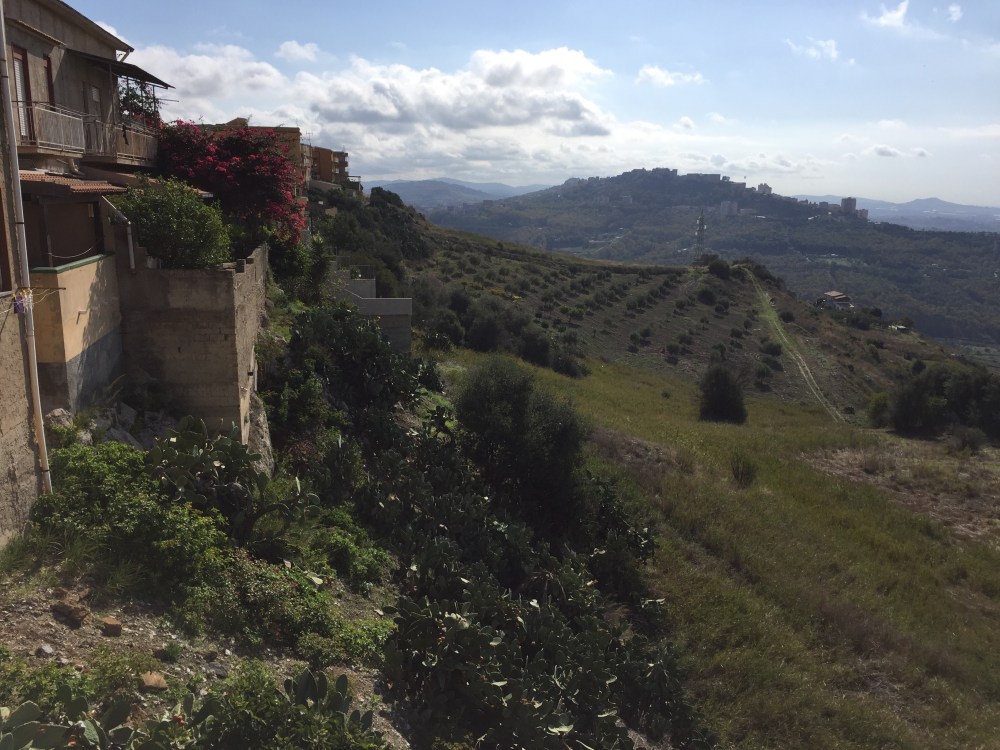
Montaperto is a small town perched on a hill, home to less than 500 inhabitants and surrounded by a rolling landscape that I have come to love during my short month on the island of Sicily, both the hills and the sea seemingly always off in the distance. The village is the former home of the Taibi family who have been producing their award-winning Olio Taibi extra virgin olive oil since 1867. Giuseppe, the family’s 4th generation member upholding the craft, is giving me the grand tour.
The village is part of the province of Agrigento. Originally named Akragas by the Greeks, one of the island’s many conquerers, the region is famous for its temples. During the day, they are crowded with tourists; at night, empty and illuminated by spotlights that create a stark contrast against the dark night sky and the city behind. Looking up from the wheel of a car on the windy roads below, you are constantly reminded of just how ancient this area is, and the mosaic of cultures – Italian, Greek, Arab – that have all contributed to the rich and diverse history of this much sought-after land.
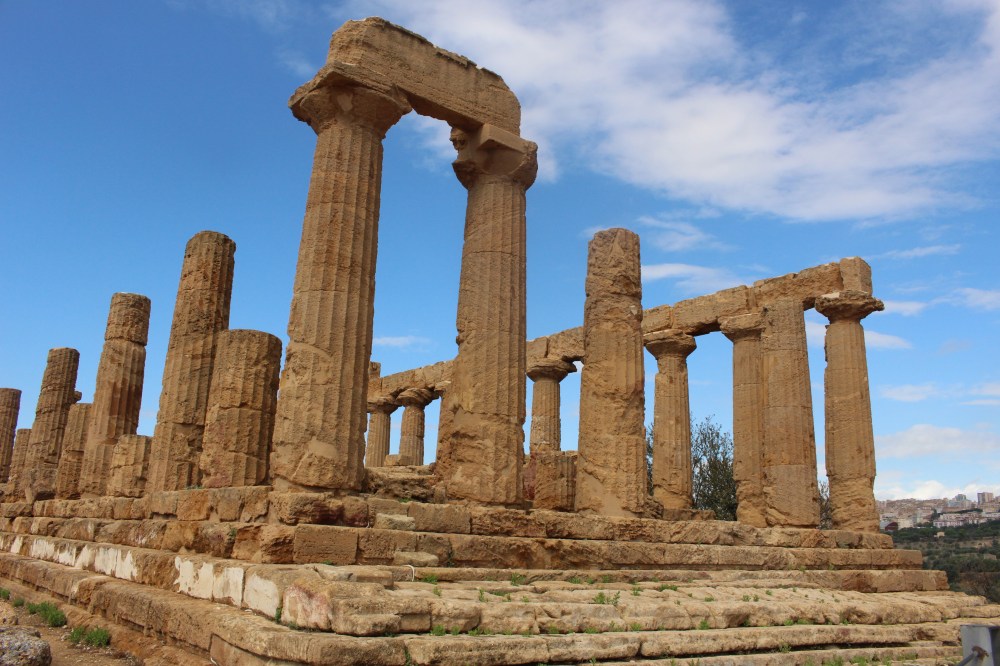
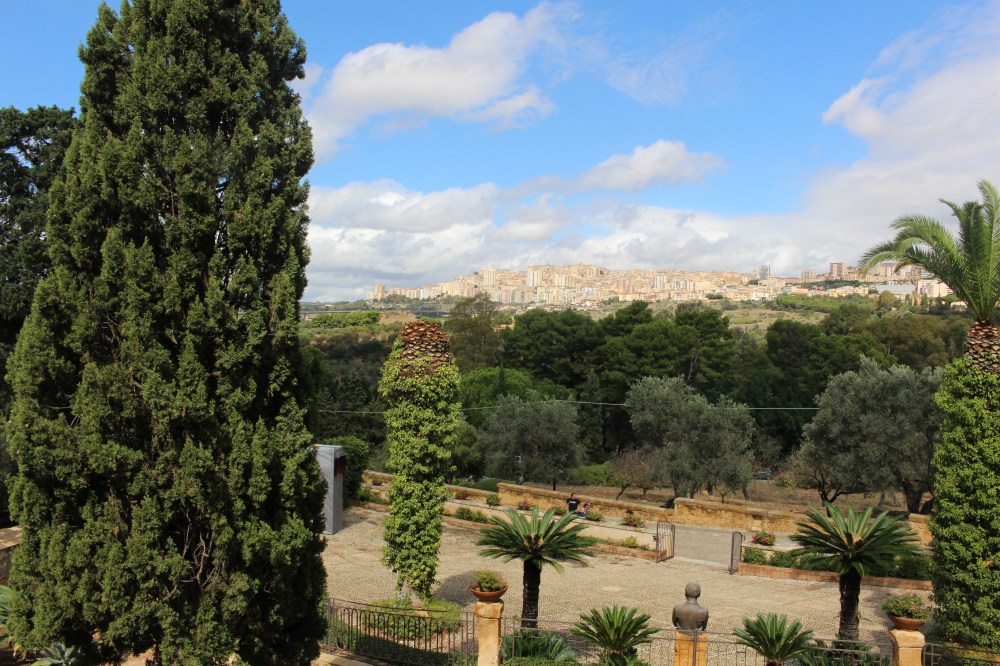
I’m here to witness the olive harvest, la raccolta delle olive, and we’ve decided to make a pit stop on the way to the groves for a brief tour of the hometown of the Taibi family.
We park in the town center, a picture of small town Sicily in all its glory. There is 1 church, where Giuseppe was married and where his two daughters were baptized, and a small bar that is currently visited by 4 men sitting in plastic chairs, snug in their pants and jackets on this sunny, 75 F day, chatting with the steady breeze floating their cigarette smoke through the air and looking perfectly content to remain there all day.
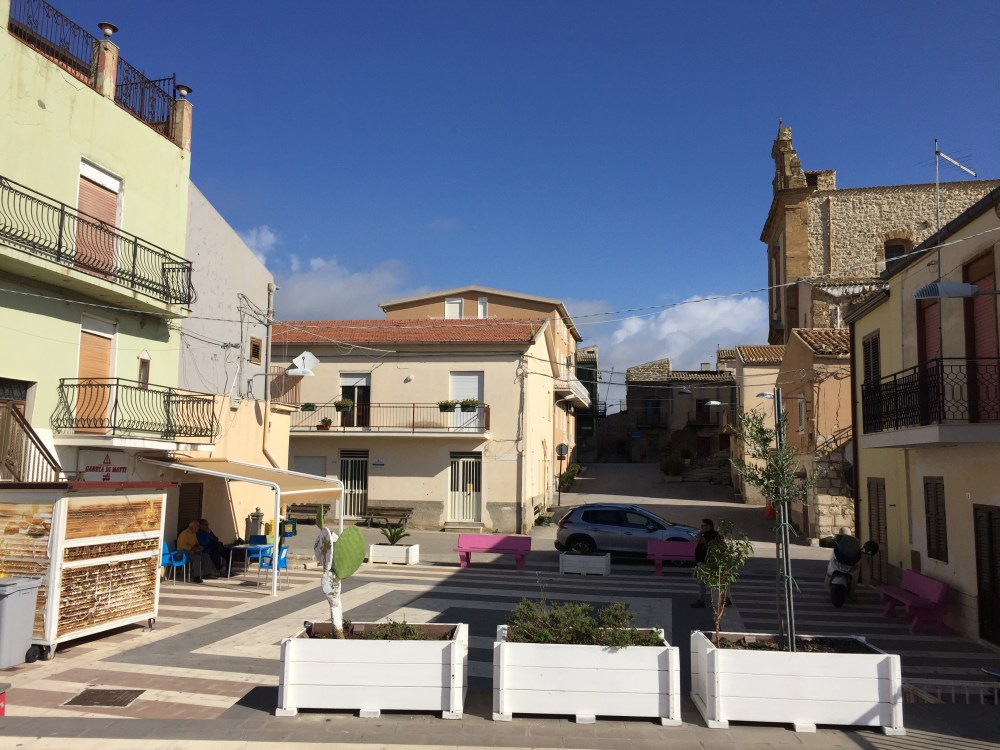
Around the corner on a quiet, bright street exists Giuseppe’s childhood home, the “Cortile Taibi” sign faded from the sun and just barely legible. We can hardly walk a few feet without coming across an old family friend, and we’re soon whisked away with the promise of fresh ricotta.
Through the back door, I’m handed the treasured cup of warm ricotta that has just arrived from the shepherd, my first taste of the cheese at its peak freshness and a precursor to the weeks to come, slowly savoring each tiny spoonful as I take in the scene.
As has become quite common during my time in Sicily, I find myself the only woman surrounded by men discussing matters in a dialect I can’t understand.
Sicilian, which is considered an entirely separate language from Italian, is full of softer, blended “sh” and “ju” noises, and when spoken quickly as a native speaker in any language does, it bares almost no resemblance to Italian. The first time I heard it I just stared, fascinated…and completely oblivious. I try to listen in and understand bits and pieces. They’re talking about the year’s olive harvest, and you can tell they are excited to see Giuseppe is back home even for just a bit.
It’s one of those moments where I can’t believe where I am, what I’m doing, or how I got here. This is what I had been after: discovering the life of a producer, the purity of ingredients, and an authenticity I could not have witnessed if I had not reached out to Giuseppe almost a year earlier.
This is where the roots of the Taibi family lie, and where the story of Olio Taibi begins.
…
When I find a food I love, I want to know everything about it.
This particular love, of the bright green fruit juice that is the living, breathing soul of Italian cuisine, is of recent discovery. Up until I was unexpectedly launched into its world through my job at Eataly, I had never thought much about it.
Growing up, olive oil played a minor presence in my family’s kitchen. My blended background of Scottish, Irish, English, German, and Italian lent itself to dinners representing a hodgepodge of foods and dishes that I loved for the simple reason that they were homemade, familiar, and comforting. Like many Americans, a bowl of salad at dinner was accompanied by the choice of a variety of cream-based, store-bought salad dressings, and any form of cooking that required oil usually employed the canola or vegetable varieties.
When I did start shopping for myself, occasionally buying olive oil for the vinaigrettes I discovered were far better than any other store-brought dressing, the bottle I plucked off the shelf was usually a matter of price. I would never even think to look for a harvest date, let alone the country of origin.
These details have now become so ingrained in my brain that I can’t imagine going backwards. To put it bluntly, I’ve become a bit of an olive oil snob, but to be fair, with my training at work, it was inevitable. I drank the Kool-Aid, or more appropriately (and literally), I drank the olive oil.
…
I started working with Giuseppe as a part of my local producer-liaison role at Eataly. Being a native Sicilian whom also happens to live locally in Lexington, MA, Giuseppe has a unique perspective to offer. He is of course an expert on his own Italian culture, and having lived in the US for several years now, he has a deep understanding of the American market. His proximity to Boston also means that we see a lot of him, personally hand-delivering his orders and always sticking around to demo his product for a few hours. In addition to keeping up his family’s tradition, he is also an accomplished engineer, and juggles these two careers while traveling back to his hometown every year for the harvest.
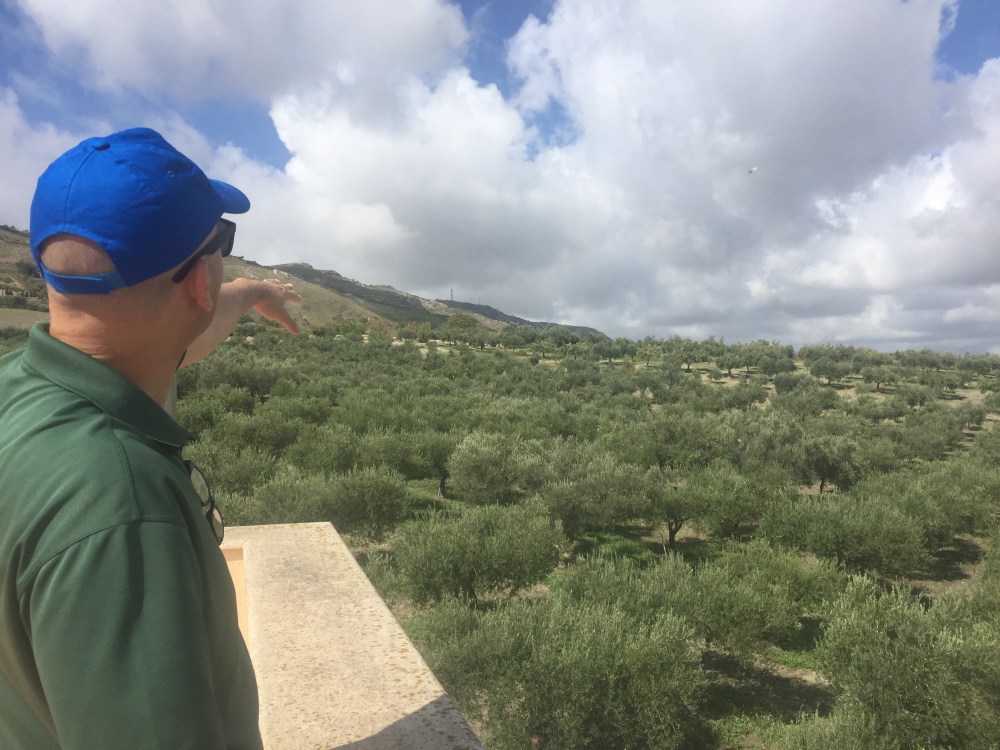
When I decided to spontaneously extend my trip to Italy from 5 days to 3 months, I had little idea what that time would entail. Food, yes…but how? My new fascination with olive oil made one thing obvious: I wanted to witness the harvest, and I was hoping Giuseppe would let me tag along. I crossed my fingers and prayed my long, rambling email explaining my trip and desire to visit his farm would be warmly received.
And it was! Giuseppe enthusiastically responded to my request, and just like that I had my first real plan for this trip. Since I now knew I would definitely be going to Sicily, I decided I wanted to do it well: I chose to dedicate a month to the island, without a real plan in mind. But with Giuseppe’s advice over the next few months of where to stay, what to see and, most importantly, what to eat, I soon had a jam-packed itinerary of farms and producers to visit. I was so excited to see his work in action and spend a month immersed in a place I was told would be a completely different world than the mainland Italy I’d become familiar with.
…
I arrived in Agrigento on a cool, rainy afternoon, uncharacteristic for the island which is known to have the most sunny days in all of Europe. “When it rains in Sicily, we run inside,” the owner of the agriturismo told me, a sentiment soon echoed by many Sicilians I’ve met from all points of the island.
As a result the olive harvest was delayed. What typically begins in mid-October, the harvest has been arriving earlier and earlier each year with the change in weather. We would have to wait for the soil to dry out, an otherwise extremely muddy venture within the groves.
I welcomed this delay: it meant that I would need to extend my stay in Agrigento a few days longer, giving me more time to explore and learn about the history of the beautiful land that bears the fruits I had come so far to learn about.
While we waited for the land to dry, Giuseppe showed me around: Valle dei Templi, the historic city center, a seafood feast in nearby Porto Empedocle with his childhood friend and bestman, a breakfast of traditional pastries filled with pistacchio cream and the shiny, colorful marzipan fruit…it was my first glimpse of Sicily and I was so grateful for my own personal guide.


We also visited Il Giardino della Kolymbetra, home to the largest variety of ancient citrus I have ever seen. It’s here that I met Enzo, its caretaker, who handed me fruit after fruit, naming the different varieties with ease – lemons, persimmons, oranges – as we walked through the garden. He has a profound knowledge for the plants, and is a dear friend of Giuseppe. He is also in charge of looking after the Taibi olive groves. There’s a sense of trust in caring for his land and Giuseppe acknowledges this, “I knew he was the right one for the job.” The upkeep for a garden like this with so many different varieties, in addition to the olives, is no small feat, and it’s all Enzo.


The delay of the harvest gives me a glimpse of the month to come, and I’m thankful I gave myself so much time to explore the island. I’m immediately taken with its biodiversity and natural beauty, the prickly fichi d’india sprouting up everywhere, scurrying lizards warming in the sun, and gigantic, prehistoric-looking plants.


The sun has been kind to us and after a few days, the land is dry enough to begin the harvest.
…
Il Processo – the process
La fattoria – the farm
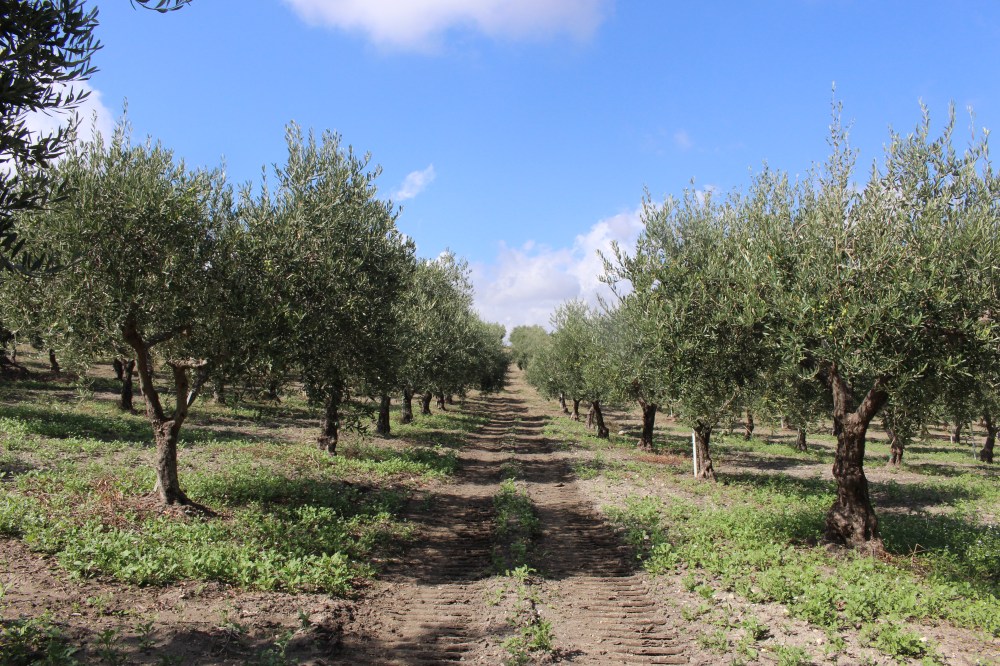 We arrive late around noon after our visit to Montaperto, the azienda a short drive from the village on the hill. The workers have been hard at work for several hours by now having begun in the first warm rays of the morning around 7:00am, and we immediately head off into the trees to catch them before they break for lunch.
As we make our way, our feet crunching down into the soil, I realize the importance of waiting for the land to dry, and how difficult this work would be otherwise. Even after several days of patient waiting, the soil is still slightly damp and soft – smelling, looking, and feeling of pure health with its rich darkness – but the past few days of warm sunlight have cracked it dry enough to allow the passage of boots and tractor.
We walk through the groves in search for the crew. It’s my first time being surrounded by so many olives, the branches heavy with hundreds, bright green and ready for harvesting.


Giuseppe examines the trees and points out the different varieties. Sicilian olives are most commonly of 4 types: biancolilla, nocellara, cerasuola, and giraffa. At Olio Taibi they cultivate the first two: biancolilla and nocellara.
Although on the tree both are visibly the same brilliant shade of green, upon inspection one can immediately notice the difference: the biancolilla smaller and more narrow, the nocellara larger and fuller containing enough fruit to brine and pop one after another for the perfect snack.
While grown together in the fields, alternating the variety in each row, the olives at Olio Taibi are pressed separately in their transition to oil. This creates a monocultivar olive oil, a rare practice in an industry where most oils are multicultivar and consist of a blend of a farm’s varieties.
It is not to say that one is better than the other – it of course depends on the production of the farm and the desired taste, among other factors – but it is something that differentiates Olio Taibi from other olive oil producers, and something I have come to appreciate while trying to get a hold on this huge world of olive oil I had no idea existed.
Why press olive varieties separately? By doing so, the identity of the olive is maintained from farm to bottle: you can take a sip and assuredly say, “This is the taste of the nocellara olive.” Side by side with a different monocultivar oil, you can learn their subtle differences and discover their pure taste unique to that particular olive.


For example, while Taibi’s biancolilla oil “exhibits fruitiness, green grass, almond, sweetness, bitterness, medium pungency, and notes of red pepper,” the nocellara oil is “decisively fruity and peppery” – it all comes down to the olive variety.
The contrasting tasting notes of the oils also make it easier to understand their uses and inspirations for a wide variety of dishes: in general the delicate biancolilla is perfect for dishes typically paired with white wine such as salads, fish, and cheeses, while dishes that can hold up to stronger flavors – red sauces, roasted meats, and pastas – are perfectly paired with the more robust nocellara.
There’s a reason why it helps to compare olive oil to wine: the two are very similar in their reflection of the terroir of the land, and their uses are equally as diverse and complex. In my opinion, tasting the simplest and most pure varieties first – in this case, a monocultivar oil – has been a great way for me to get my footing and understand what I do – or don’t – like.
As I’m holding each variety in my hand, rolling the olives around between my fingers, the surreality of the moment hits me. These two names – biancolilla and nocellara – have become so familiar to me in Boston, repeating them with ease in my communication with customers and typing them in my orders to Giuseppe – yet up until now they didn’t mean much. Now that I’m here, in Agrigento, touching the very olives that will become the oil on our shelves, I have a new found appreciation for the little green varieties in my hand.
…
This daydream is interrupted by a faint buzz emerging from the trees that was unnoticeable until now: it’s the sound of the spiratore, the shaking metal rake that knocks the olives from their branches, and this, accompanied with the faint chatter of the workers, tells us we are near.
It’s to my pleasant surprise that the harvest has begun with the biancolilla olives. It’s my personal favorite of the two, each opening of the bottle warranting a wiff of the pure scent of freshly cut grass of which I can never get enough, and I’m excited by the inevitable future of tasting it newly-pressed at the end of the day.
The crew at work is a small one for a job this large, but they work efficiently from tree to tree. Two are armed with the spiratore while the others manipulate the nets that catch the falling leaves and fruit. Once the tree has been sufficiently cleaned of its olives, they gather the nets, pouring their contents with a satisfying rumble into a large crate on the back of a small tractor. It is the job of one worker, Enzo’s son, to drive back and forth between the groves and the main house to deliver the full crates of olives.
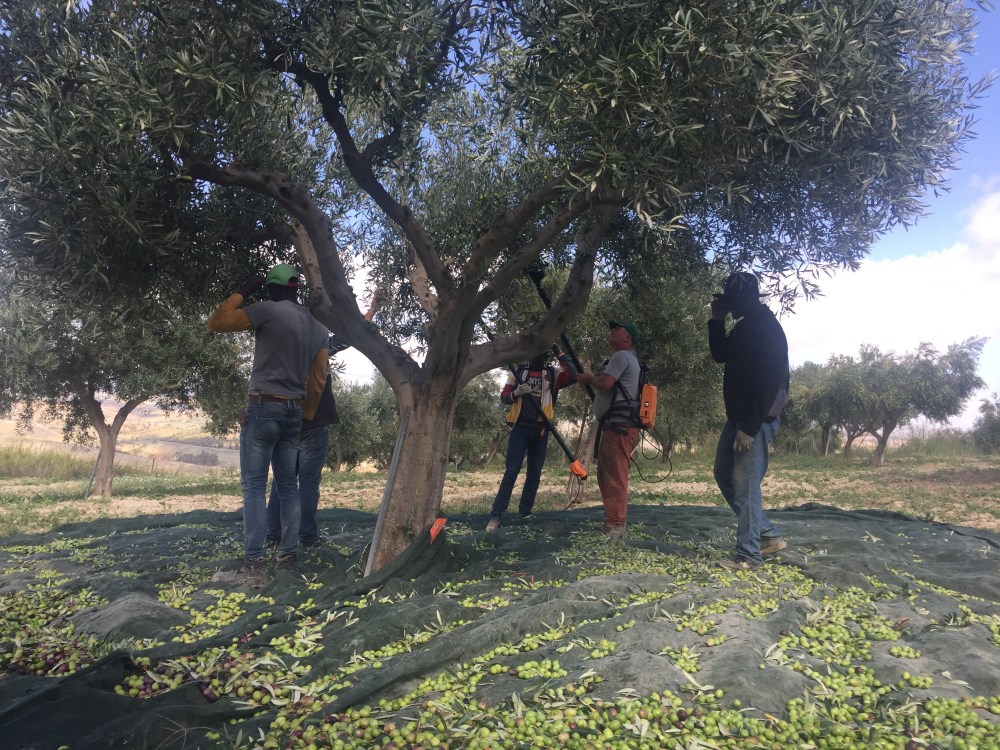
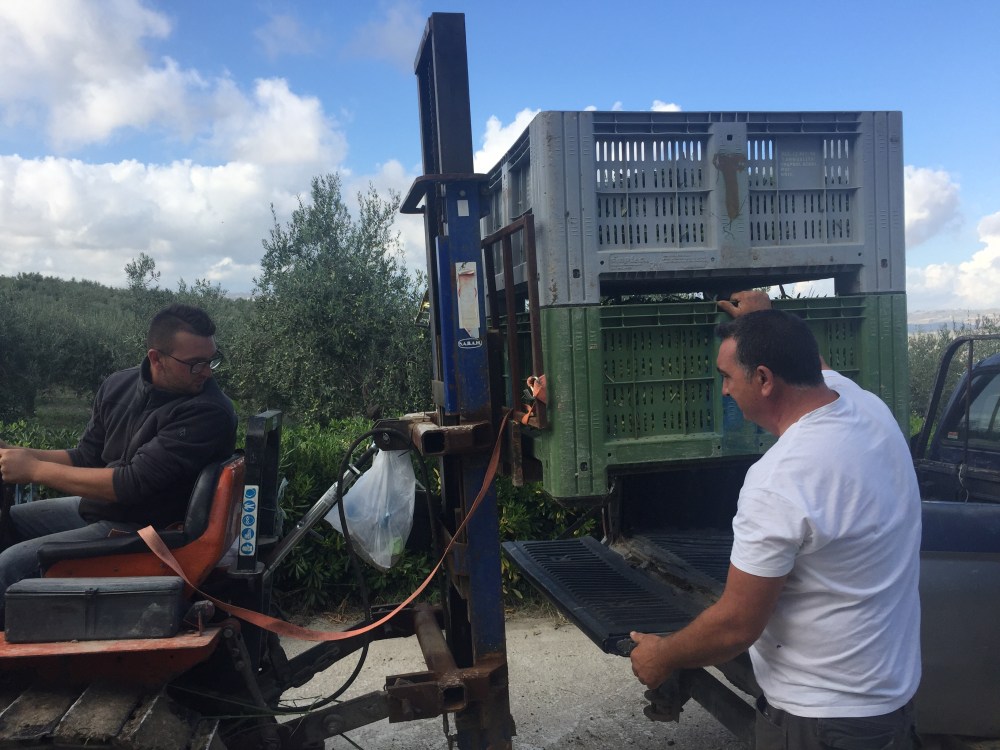
Giuseppe chats with the workers in Sicilian, and from what I can gather it has been a good morning: they’ve already collected 4 crates and are moving along nicely.
I too spend some time talking to the crew and am warmly greeted when they discover I am from the US. “America! You can do anything there!” The utopian ideal of the land of opportunity and freedom still holds true.
Besides Enzo, his son, and a man with a loving nickname that I can’t remember who are all native Sicilians, the remaining workers all hail from Africa, making up a growing population of migrants on the island. One speaks English very well and tells me he is from Guinea along with his friend, and the other young man is from Mali.
He describes a life dictated by the seasons, a life known well by those who live on the island and make a living off of its fruits. When he’s not working on the olive harvest in October, it’s almonds in July, and pistachios and grapes in September. The rich variety of foods cultivated in Sicily and their punctuated harvesting lends the opportunity to work the land throughout the year, floating from farm to farm with the changing crops as their picking time arrives.
There’s a palpable sense of respect during the harvest: for the olives, for the land, for the process in which they play a crucial role, and for each other. Giuseppe’s relationship with his workers is close, and he recognizes the value of being present. He explains it not only keeps them on their toes, but also lets them know he appreciates their work.
And it’s tiring work, but they seem happy. When asked if he likes the Taibi olive oil, one worker says it’s delicious, so fresh. “It’s beautiful out here.”
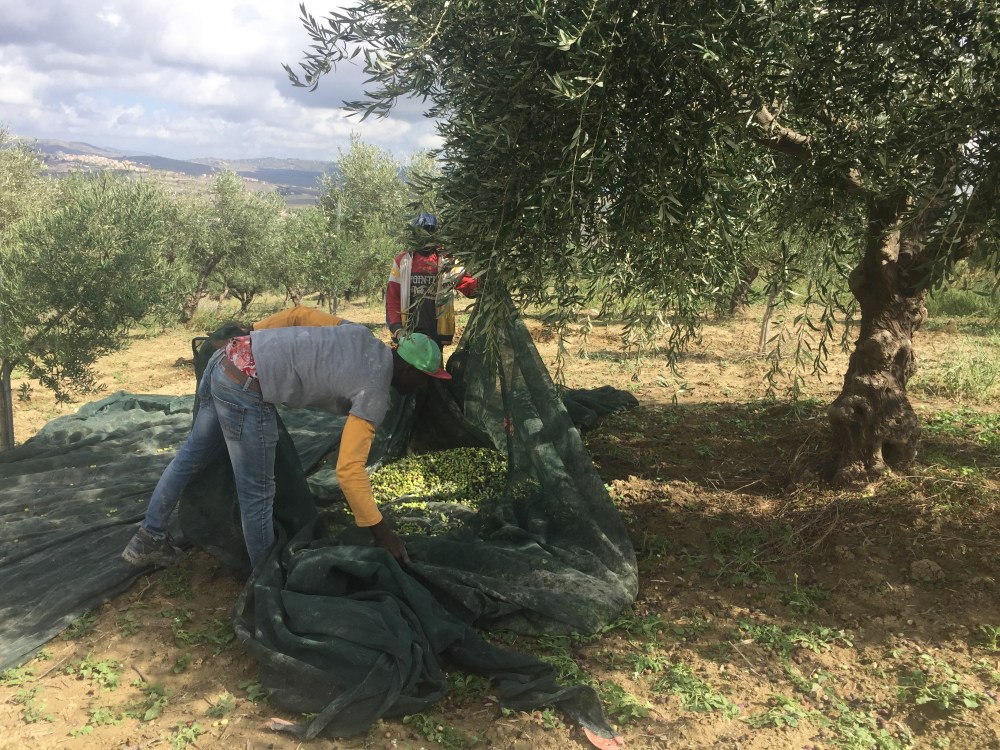
Despite the demanding motions of reaching and lifting, there’s an air of relaxation and time seems to pass quickly as they joke around with each other in a mix of their native languages and the Sicilian dialect, which they tell me they’ve picked up despite trying to learn conventional Italian.
I spend the afternoon wandering around the fields, wielding a bucket and attempting to be helpful by picking off any remaining olives after the workers have passed through.
It’s therapeutic work: I’m enveloped in my favorite kind of weather – the perfect combination of hot sun and cool sea breeze, the ideal recipe for olive growing – left alone with my thoughts amongst the trees. I feel as if I could do this for hours.
…
While in my zen-like state, I come across some critters.
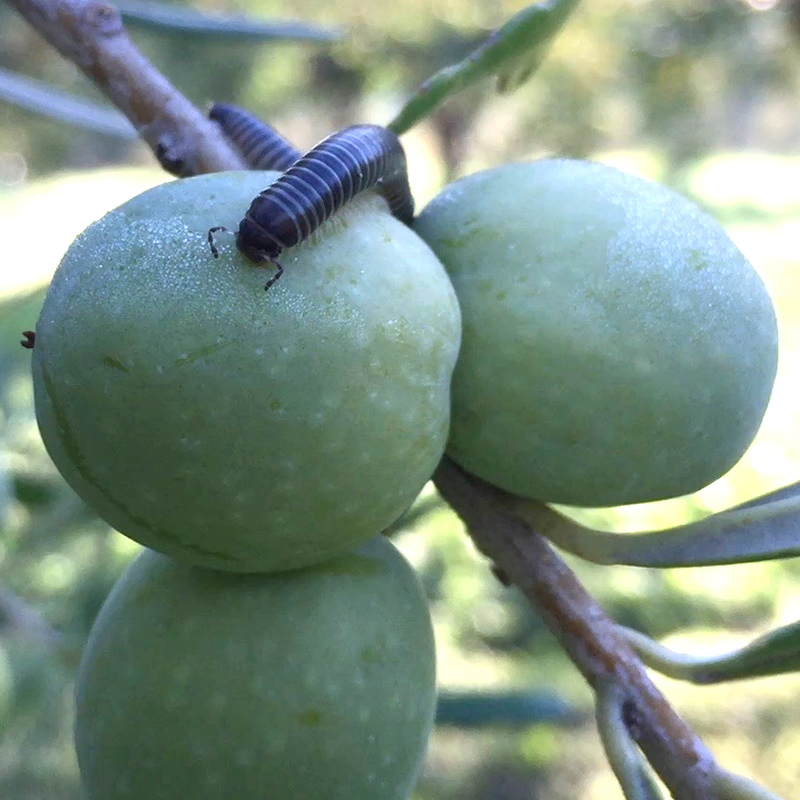
The farm is entirely organic, and it’s obvious: there are happy caterpillars climbing the trees, the soil rich with worms and other creepy crawlers that would otherwise be absent with the use of harsh pesticides. Giuseppe is on a mission to get a photo of one of the many butterflies flitting around, perched in a rare moment on his olives, and he stops everything to quietly crouch with his phone, snapping away.
Choosing to be organic can be a risk given the challenges facing olive oil producers today. Without the use of pesticides, some organic Italian farms have been subject to the wrath of the fly that threatens the world supply of olive oil. The fly transmits Xylella fastidiosa, a bacterium that spreads Olive Quick Decline Syndrome (OQDS) from tree to tree, wiping out year’s supplies of olives all over Italy, especially in the stiletto-heel region of Puglia.
It can be daring for organic farmers to leave their entire harvest vulnerable to the fly, but for Olio Taibi and many other organic farms around the country, it is the right way and thus the only way. But it’s not pure luck that the fly has not plagued the Taibi olives as organic pest control is possible, and Giuseppe has taken active measures to prevent their infestation through the use of natural traps.
In 2016, olive oil production in Italy alone was down almost 50% (ABC News). The fly has been a major contributor, but it is not the sole reason.
In terms of predators, other than the fly olives are relatively care-free – their bitterness and hard, pitted-centers make them unpalatable to birds, for example.
Weather remains the biggest threat, and olive oil-producing countries around the world are all feeling the effects of climate change. Italy, Greece, Tunisia, Spain, to name a few, all have the ideal environment for oil production, but recent changes in weather patterns have caused their yield to suffer.
Uncharacteristically wet summers provide a constant threat of rainstorms that prematurely knock the olives from their branches, or an excess of fluid that produces fruit containing more water than oil.
As I mentioned, it virtually never rains in Sicily, the long, hot, dry summer and breeze from the Mediterranean perfect for cultivating olives. In Agrigento, beginning the harvest at the right moment in October, before the rain arrives, is essential. Although the harvest was delayed a few days this year because of rain, Olio Taibi was lucky in that the olives remained strong on their branches, not many lost to the harsh rain.

In contrast, just a 150 miles away from Agrigento on the northwestern coast of Sicily in Partinico, the Taylor-Simeti family at Bosco Falconeria, where I WWOOFed for 2 weeks after my time with Olio Taibi, is having a year without olives: the summer was simply too wet and humid to produce the fruits. But they’re not perturbed: it is common for the trees to fluctuate in productivity from year to year, and last year’s ample harvest produced enough to fulfill this year’s orders.
Those making a living off the fruit juice will have to deal with more and more challenges as conditions change, but this year’s harvest is living proof that staying ahead of the game is possible, and I feel fortunate to have been able to visit during such a plentiful year at Olio Taibi.
…
Since everything is organic at the farm, you can technically eat anything that grows out of the ground (within reason), and we find our lunch growing amongst the trees.
Often viewed as a weed due to its abundance and ability to pop up everywhere, buragine (burrania in the dialect) is a leafy green that grows throughout the Sicilian landscape and is characterized by its velvety, somewhat prickly, leaves. We find ample bundles on our walk back to the house and within minutes in a sauté pan, its tough stems and large leaves wilt down like spinach, bright green and rich with nutrients.


Our meal is quickly formed in a way that appropriately reflects the land around us, with olives playing the starring role: the burrania sautéed in (and topped with more) biancolilla oil, a few of their precious nocellara olives cured in water and bay leaf, slices of local cheese, and thin, crispy pane carasau from Sardegna. It’s the way I love to form my meals at home – a few ingredients, things to pick and choose from – and there’s something so satisfying about eating a meal created by the very land surrounding you. Washed down with an Aperol spritz, it was perfect.
A quick espresso to wake us up from that post-lunch slumber-feeling, and we’re back out in the fields. I continue my work hand-picking the leftover olives, and before we know it it’s 5:00pm: the day’s picking is done. The tractor is loaded with the final crate of olives, along with the tired workers whom hop on the back for a ride to the main house.


It’s been a productive day: we have a total of 8 crates of olives, all of which are impressively stacked and manipulated onto the back of Enzo’s white pickup truck.
An old bottle of grappa appears out of thin air and Giuseppe gives a quick toast for the day’s harvest. The workers head for home for a restful night’s sleep before beginning early again tomorrow, while Giuseppe and I follow Enzo to the mill – the day’s work is not over yet!
Il frantoio – the mill
“It would be unthinkable for anyone to leave his olives at the press and go home until it was time to come and pick up the oil. The journey from tree to oil jar must be accomplished under the padrone’s eye to insure that no olives are exchanged or subtracted, nothing added. And so while the olive sacks stand in line, their owners gossip, play a hand of scopa, stretch their legs along the dirt road the leads to the highway, or catch a nap in their cars.” ~ On Persephone’s Island, Mary Taylor Simeti
It’s in this sentiment that we arrive at the mill, prepared to keep a watchful eye on our precious olives as they become oil. I have been waiting to witness this process for months now, and I’m ready with my camera and a head full of questions.
While some farms have their own mills to press their olives, the practice of using a shared mill is much more common. Small- and large-scale producers, along with families making oil solely for their personal use, pay a fee to the local oleificio (oil press) to utilize their machinery. Giuseppe has been using Oleificio Principe for years, and I meet the father, mother, and brothers who run the family business.


Since it’s olive harvesting season all throughout Sicily, we’re not the only ones at the oleificio tonight, and we have to wait our turn. It’s not a problem though, because it gives me time to sit back and observe an environment that I’ve come to love after visiting several oleifici over the course of my month on the island.
Men, and a few women, arrive with their crates of olives in varying sizes and shades, grabbing a seat or standing in a circle with their arms crossed, chatting and sharing the woes and successes of this year’s harvest with an espresso in hand. They pleasantly pass the time as they await their turn at the press in a loud room perfumed with the smell of olives, the machinery hard at work. It’s an economical solution with a surprising social benefit, and a centralized location for all levels of production where producers can watch the transformation from start to finish.
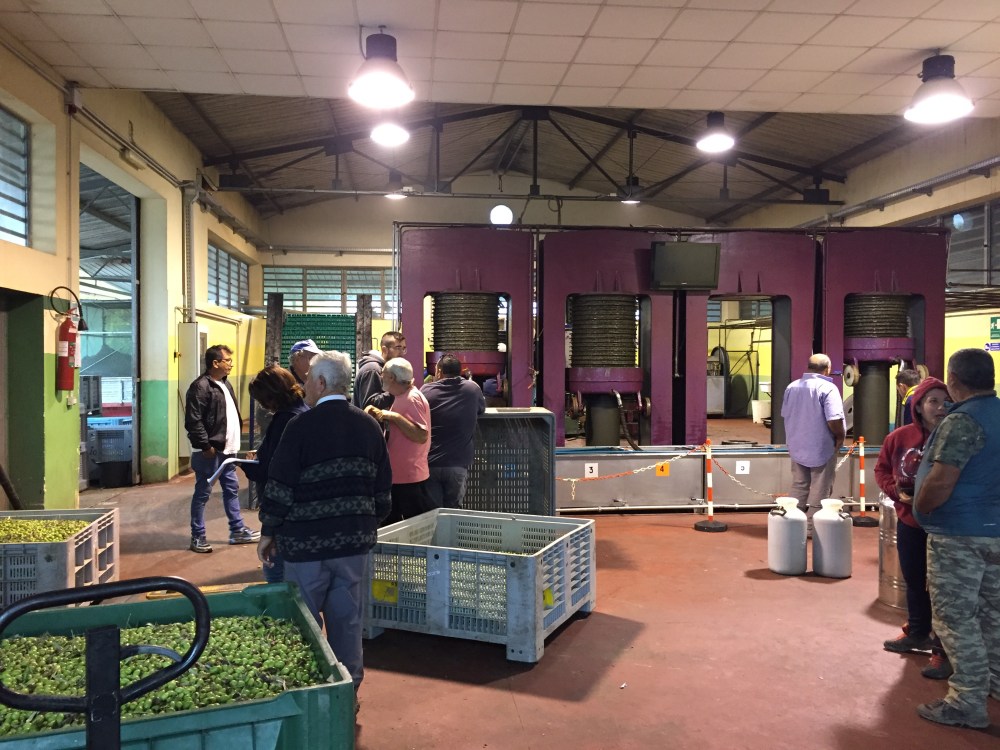
For small farms producing oil solely for their personal use, they await at the end armed with large plastic jugs that they fill with their fresh green juice. Sometimes they produce more oil than their family needs, and the oleificio is able to buy it from them and sell it. For larger producers that bottle and sell, their oil is stored in large metal tanks until packaging time. In this way bottling, labeling, and shipping all occur at the same facility.
While organic farming in Sicily is widespread (1/3 of all organic farms in Italy reside in Sicily – The Sicilian Experience), not all the producers who utilize the shared mill are organic. This means that all the machinery must be washed and rinsed as they switch from organic to non.
Around 7:30pm our turn arrives, and I watch as all 8 crates are loaded onto a scale: approximately 2680 kg of olives. This initial number is important, as it will tell us our yield at the very end. Giuseppe says we’re aiming for a 15% yield with the biancolilla, an olive that has a higher pit:fruit ratio than the nocellara and thus produces less oil.
This number shocked me at first – only 15% of the weight of the olives becomes oil? That sounds kind of low, doesn’t it? In reality this number is a fine balance, and a larger yield isn’t necessarily a good thing.
I come to learn the importance of harvesting the olives when they’re still green, picked before they become ripe and a dark black color. Riper, darker olives do produce a higher yield, but this is due solely to the weight of the resulting liquid, not the oil content. In reality, oil produced from riper, darker olives has a higher content of water than oil produced from green olives picked before maturity – and we’re trying to make oil here, not water!
Picking the olives when they’re still green may not maximize the final volume of liquid you obtain, but several studies have shown that picking olives at this point maximizes the health benefits of the oil, obtaining an olive and thus an oil at peak nutritional value (“Monocultivar Olive Oil”, Gino Celletti). This “sweet spot” of harvesting at just the right time changes according to the olive variety, so a crate of black olives isn’t necessarily an omen for thin, watery oil – just a different threshold for perfection.
After weighing, the transformation begins: all 8 crates are individually poured into a metal cauldron to begin the first of a series of separations, this one serving to separate out any leaves or larger materials that have come along. And what happens to those separated materials? We’ll get to that later 🙂
The olives are then passed through another pit onto a conveyer belt for a quick washing to remove larger pieces of sediment.
Once the olives are removed from any leaves and dirt, they are fed into a compressor that gives them an initial smashing – pits and all. Up until this point, all the machinery is outside the front door of the oleificio: it is now that the process moves inside the mill, the resulting paste fed through a pipe into the next container and the next series of machinery.


The next step is where the heavenly perfume of olives and their juices first emerges, and according to Giuseppe is the most important step of oil production. La gramola, the massive machinery where the smashed olives are fed into, contains separate compartments each with their own rotating blade shaped in a specific way so as to not overheat the olives. Again, we’re trying to make achieve maximum nutrition and flavor, and friction created from crushing the olives too harshly can result in a loss of both of these.
This process of grinding and mixing the paste is known as malting, and is where the actual olive oil is first produced. I stand over compartments 4 and 5 that contain our olives, mesmerized by the repetitive motion and the sound and smell of the rich olive paste releasing its oils.
Multiple producers can utilize the gramola at the same time, and a paper chart on a nearby desk dictates which compartment belongs to whom. To a seasoned producer perhaps the difference between the olive pastes becomes obvious, but I can imagine how batches could be mixed up if you don’t keep that watchful eye everyone has been telling me about. Good thing we’re in trusted hands at Oleificio Principe.
During this entire process while I’m snapping away photos and videos, Giuseppe pays keen attention to his olives, hand-picking any leaves that make it past the first separation and examining each step at work.
The process finishes with a final separation, this time with a piece of machinery justly-named il separatore. The separatore is made of two different centrifuges: one horizontal, one vertical. The horizontal centrifuge works to first separate the solid (the olive pulp) from the liquid (the oil) in the crushed olives by utilizing their different densities. A small tool then enters to extract the oil, and the liquid is left behind. Passing into the vertical centrifuge, any residual water is separated from the oil.
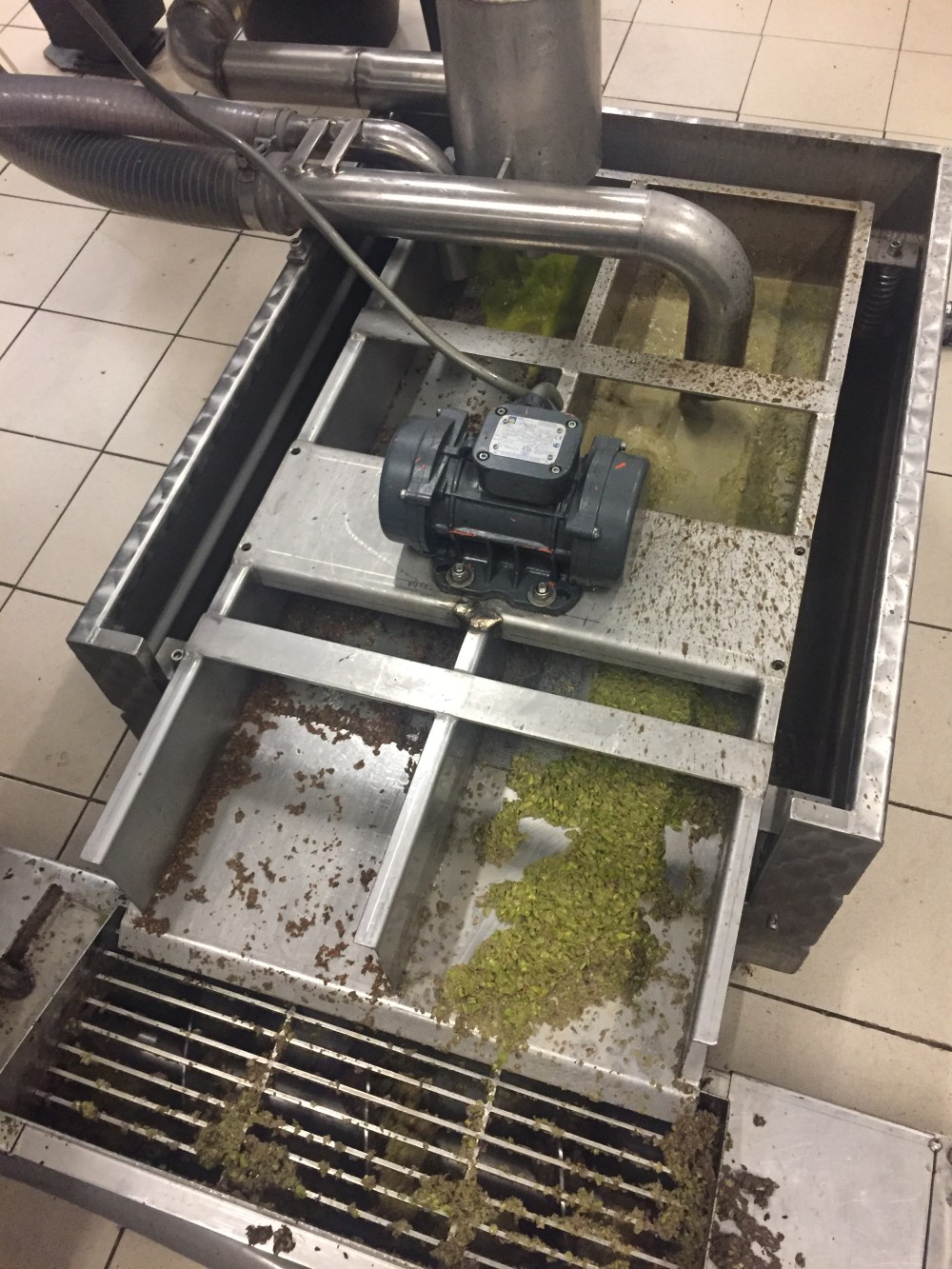
We’re now patiently waiting by the spout at the very end for that first glimpse of bright green oil. It emerges and it’s more luminous than I could have ever imagined.
Giuseppe is ready with wine glasses for a much anticipated first taste. It overwhelms my taste buds and coats the tongue without feeling heavy, accompanied by the characteristic tickly-throat feeling and resulting cough that comes from the healthy dose of polyphenols that make up an olive oil this fresh. It’s the grassy flavor of the biancollila oil I know and love, but stronger and brighter (both in color and taste) than the bottled variety I first discovered in Boston.
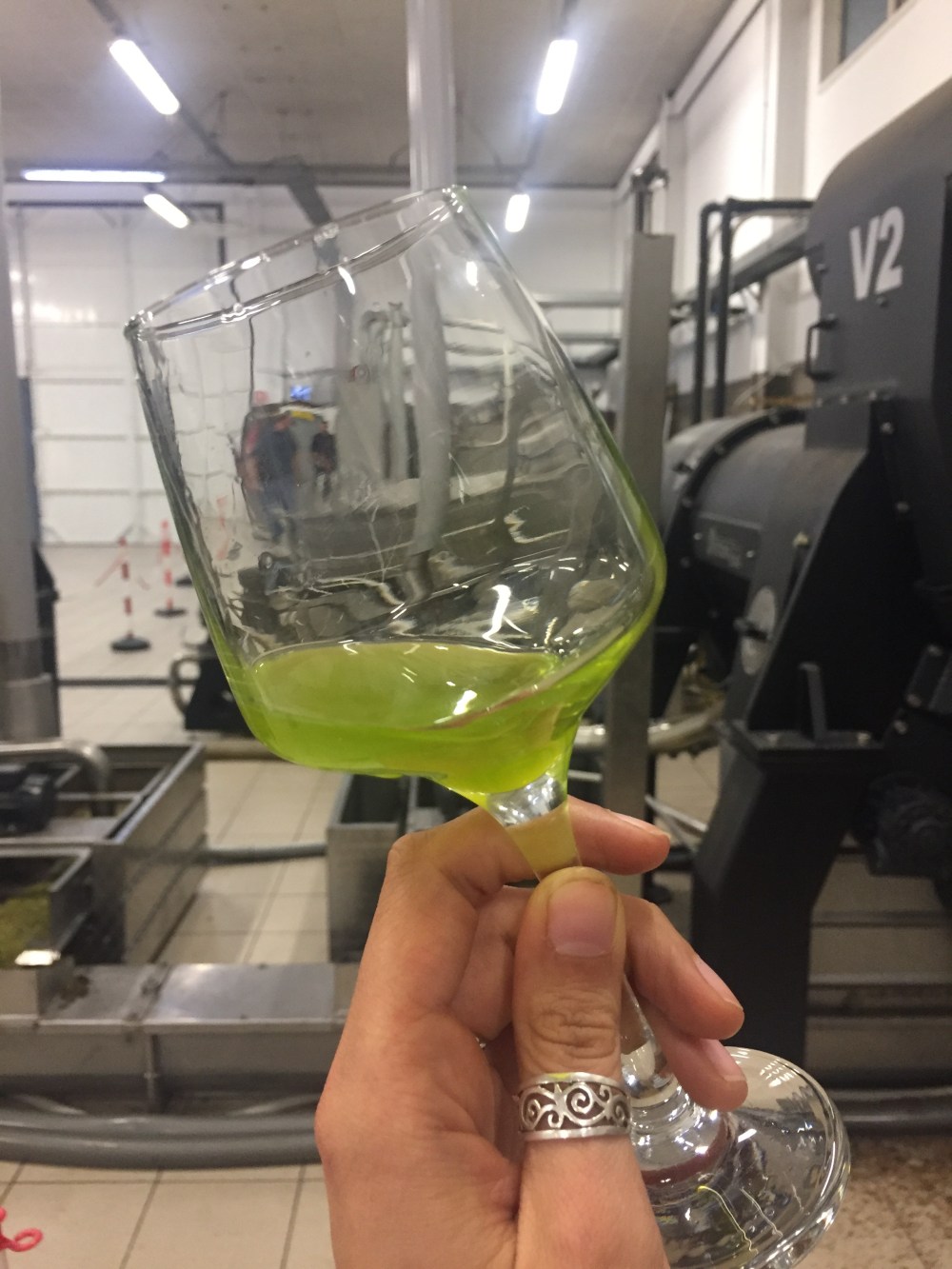
At this point the oil is unfiltered and cloudy, different from the clear liquid we’re used to in the bottles we buy at the store. This is just the first day of the harvest, and there’s a lot more oil to come: for now, today’s oil is passed into the storage tank in the back labeled “Olio Taibi Biancolilla 2018”. It is eventually filtered and decanted, a combination that results in increased shelf life and the settling of remaining sediments. The new harvest is then bottled and labeled, ready for shipping.

The final step tells us how we’ve done: the resulting oil is weighed and I watch the needle turn round and round from 100 to 200 kg and up as it pours into the tank.
After a quick calculation, Giuseppe announces the yield: 15.3%. With an aim of 15%, we couldn’t have done much better. This amounts to approximately 400 L of oil, around 800 bottles, after just one day of harvest.
I slowly sip from my glass, in awe of the process I’ve just been able to witness. Just a few hours ago I picked the olives straight from the tree, and now they’re an entirely different product – once solid, now liquid; once inedible and bitter, now smooth and one of the most treasured staples in cultures around the world.
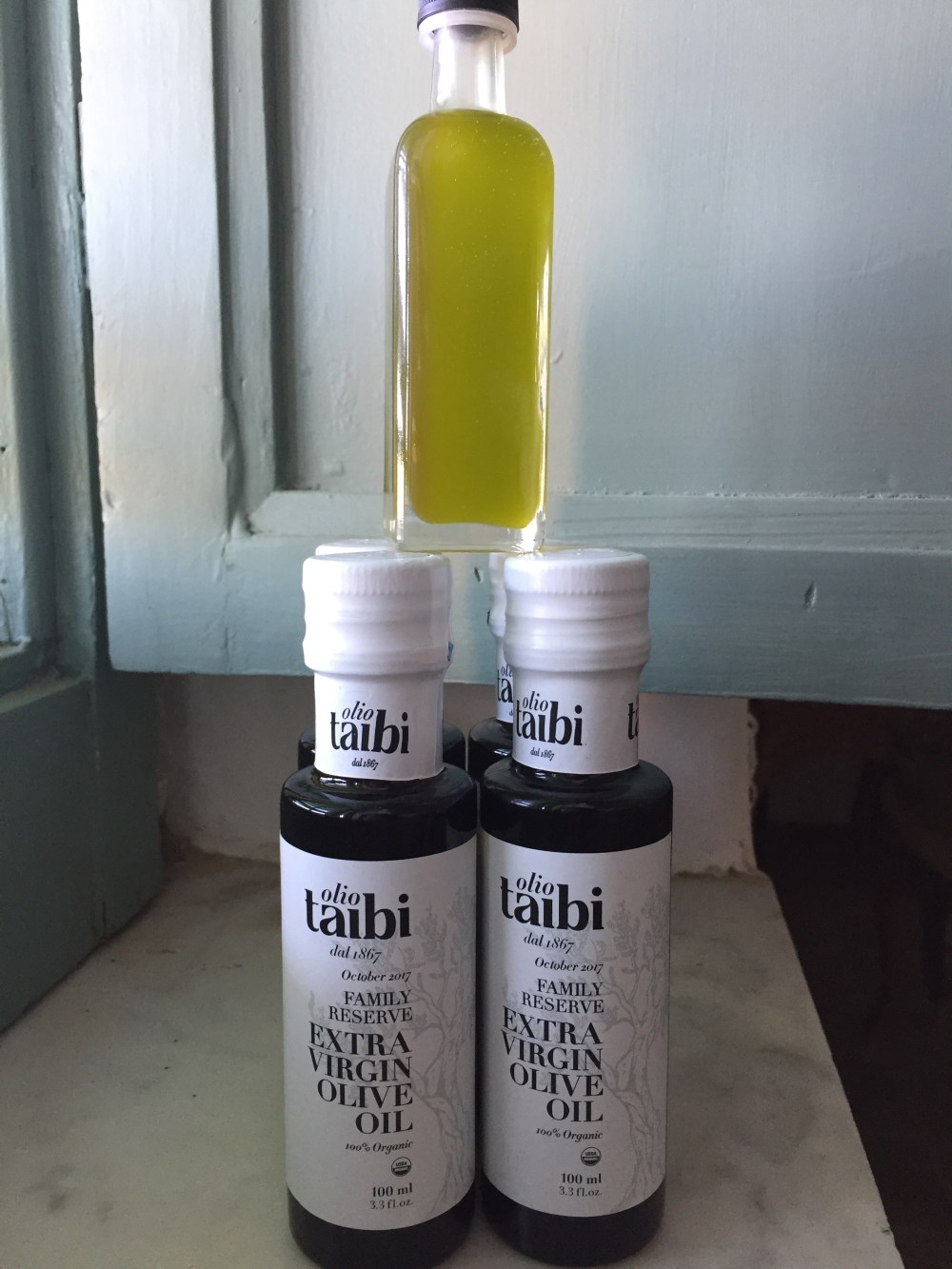
I walk away with a small glass bottle filled to the brim with the fresh liquid, a gift for the road, and treasure the moment I’ll get to use it (which turns out to be a week later in Cefalu, playing the starring role in a meal featuring solely Sicilian ingredients, the perfect topping for a plate of pasta con tenerume – the leaves of the local zucchine lunghe).
Giuseppe says we’re lucky – there have been times when he has had to wait at the mill until 2am for his oil to be ready, the lines long with producers. Maybe it’s because it’s early in the season, or maybe other farmers weren’t as lucky.
We surely feel lucky as we celebrate that night with his family, picking up a handful of varieties of focaccie and celebrating by drizzling the fresh oil pressed just an hour earlier over the warm bread. Giuseppe’s father sits at the table and while the years have passed, you can tell the annual first taste of his family’s oil remains a special and treasured moment.
…
You may be wondering what is happening to all these materials that are separated out along the way: the leaves, the pits, the water. Having an interest in waste in food production, I was too, and when I asked one of the oleificio family members, he said confidently, proudly, and simply, “Con l’olio noi non sprechiamo niente”. In other words, olive oil production is almost exclusively a zero waste process.
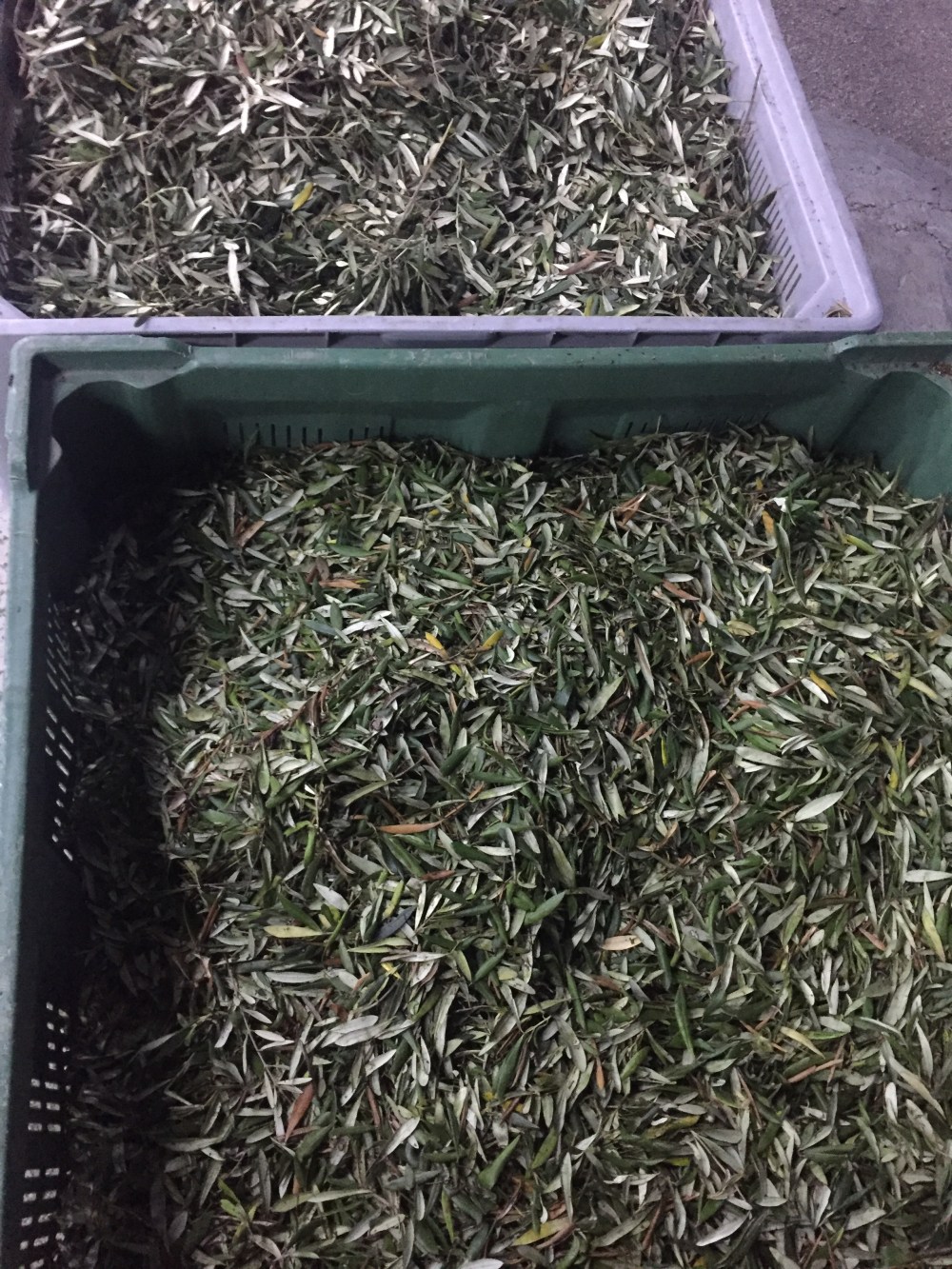
The leaves form a nutritional snack for the island’s many sheep and pigs.
The olive pulp and pits (i nocellini) collect in two separate, towering piles outside the oleificio where they are later made into pellets and burned as biofuel by the companies that purchase them.


The only byproduct that presents a challenge is the residual liquid. It cannot simply be poured back into the land for irrigation as it alters the pH of the soil and can result in sterilization of the land. Some companies are able to take the liquid and produce biogas, but the majority of the liquid is diverted to cosmetic companies where they use it to create olive oil-based lotions, creams, and soaps.
Think about how amazing this is: olive oil is produced all over the world in enormous quantities, and the process has almost no waste. With such a large reach, one could only imagine its impact if the circumstances were otherwise. It’s a theme I’ve found common to many other traditional food processes in Italy, and one that has been around for thousands of years. It is embedded in the process, the culture of olive oil, and Italian food as a whole.
…
It’s easy to get caught up in the romantic sentiments of a harvest like this, but as it is for any farmer, there are real challenges.
In Sicily particularly, there are powers at work besides the weather and the fly that have the potential to prevent the success of an up-and-coming producer. All too often corruption wins, and growing up with this in mind, Giuseppe settled in the US as a young adult, committed to make an honest living. He has an ever-expanding list of ideas for his business, one that proves that high quality, extra virgin olive oil can and should be accessible for all, and has dreams of projects involving his home town. For now he does what he can: make delicious, genuine olive oil, and share his story and passion with others around the world.


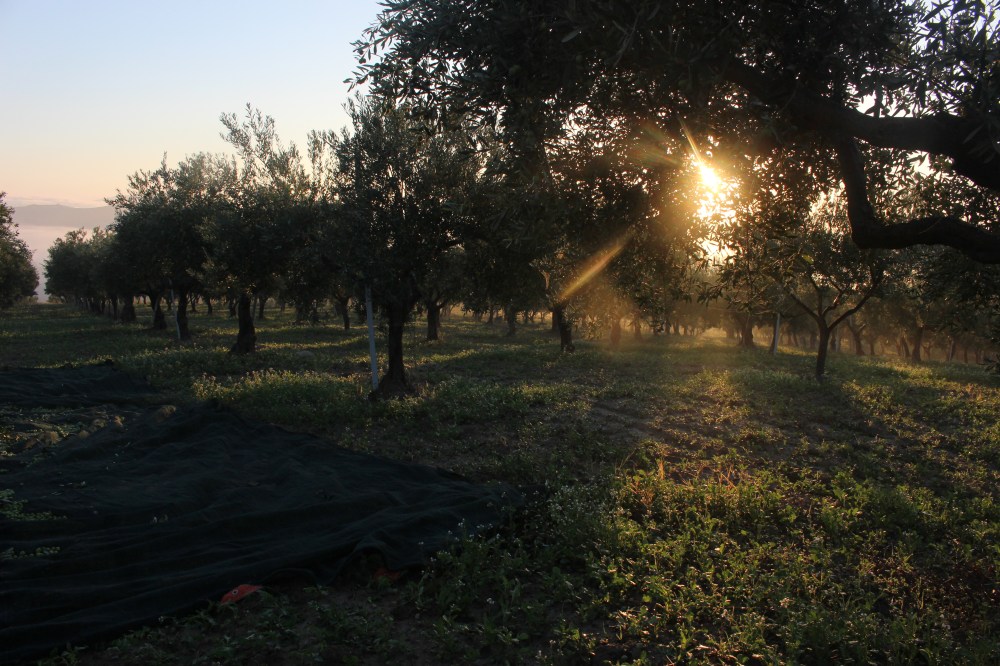
On my last day in Agrigento Giuseppe convinces me that it’s necessary for me to see the olive grove at sunrise. I sleepily rise and start the car, the morning Rai radio program enveloping my ears with soothing Italian voices as I make my way to the azienda in the morning fog.
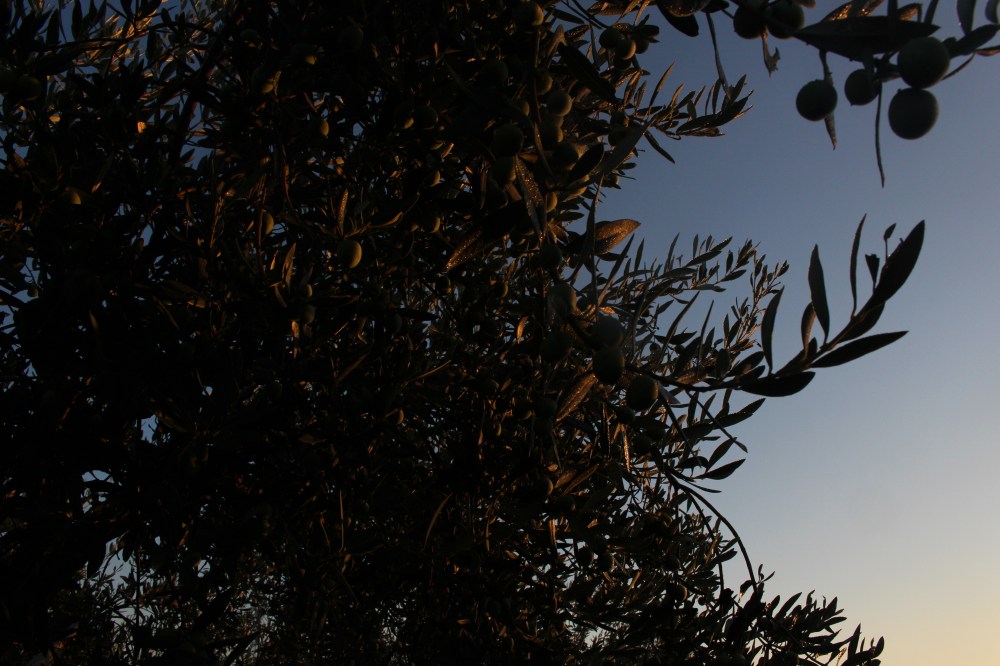
It’s worth it. The air is fresh, the olive leaves are wet with dew, and my feet are sinking more easily into the soil. If you kneel down you can see a layer of fog between where the grass and the leaves begin, the branches sparkling with olives waiting to be picked. The team is already working and they jump in where they left off yesterday evening. I stick around to pick a few more olives, perfectly content.


My time with the Taibi family in Agrigento was exactly what I came to Italy for, and I couldn’t have asked for a better introduction to Sicily, an island of wild beauty and welcoming, hospitable people. I left with a suitcase full of oil to bring back home to my friends and family, and the excitement of continuing my journey spending time with producers, learning about the history, the people, and the land behind the cuisine I relate most to.
…
Links to explore:
Some of the best olive oils in the world have Lexington ties – Olio Taibi feature in the Boston Globe (June 2018)
Gold Award for Olio Taibi Nocellara Organic Extra-Virgin Olive Oil – New York International Olive Oil Competition (2018)
Silver Award for Olio Taibi Biancolilla Organic Extra-Virgin Olive Oil – New York International Olive Oil Competition (2018)
Check out this list of recipes that utilize Olio Taibi oils!
 Orchard e Orto