To taste fresh, hot ricotta is to experience the transformation of a pure ingredient at its finest.
Simply put, that’s what ricotta is – a transformation of milk – in fact, it’s what all cheeses are.
Like many food staples of cultures around the world, cheese emerged as a way to preserve a fresh product farmers had in abundance but could not afford to waste. With a little salt and heat, the fresh milk could soon last for months instead of days, and cheese-making began.
This idea of this transformation was first introduced to me by my hosts, Francesco and Carmela of Masseria Sgarlata, where I spent a week this past October immersed in the art of ricotta at their farm in Scicli, Ragusa.
We were seated around their tiny kitchen table enjoying another late-night meal after a long day of work, and as what usually tended to happen the conversation turned to cheese.
I had just spent the day peering over the shoulder of Francesco in the latteria, eyes-wide and following his every move as he did what he does best day after day. I listened intently as he patiently explained step-by-step the process of making fresh ricotta, jotting down notes in mix of Italian and English as I began the first of many translations, in the meantime carefully side-stepping the hot, boiling cauldron of milk and trying not to disturb their work in the small square room. In the winter, the latteria is a warm haven, heated by the burning stove. I can only imagine what it’s like during the hot Sicilian summer.
In recent years, Masseria Sgarlata has been put on the map. People from all over the world, let alone this region of Italy, come to learn about the traditional ricotta process that used to be so prevalent in this part of Sicily. Today, as Francesco sadly tells me, it is a dying art: so many farms have had to give up their family’s tradition for economical reasons, or simply lack of interest in carrying on the craft.
But it is alive and well at this family-run farm, and truly family-run it is: Francesco, the oldest son, is the main cheese-maker, cranking out fresh ricotta, caciocavallo, and other traditional cheeses day-in and day-out; his younger brother, Albino, handles the administrative aspects and spends his days delivering their products to their client’s front doors in addition to some small local shops, in the meantime studying to become a vet and caring for their farm animals; Carmela, Francesco’s partner and the main face of their store-front, dining, and customer service, tells me their father, Angelo, works the longest hours of them all, waking up at the crack of dawn for another day passing on his father’s tradition with a palpable sense of pride.
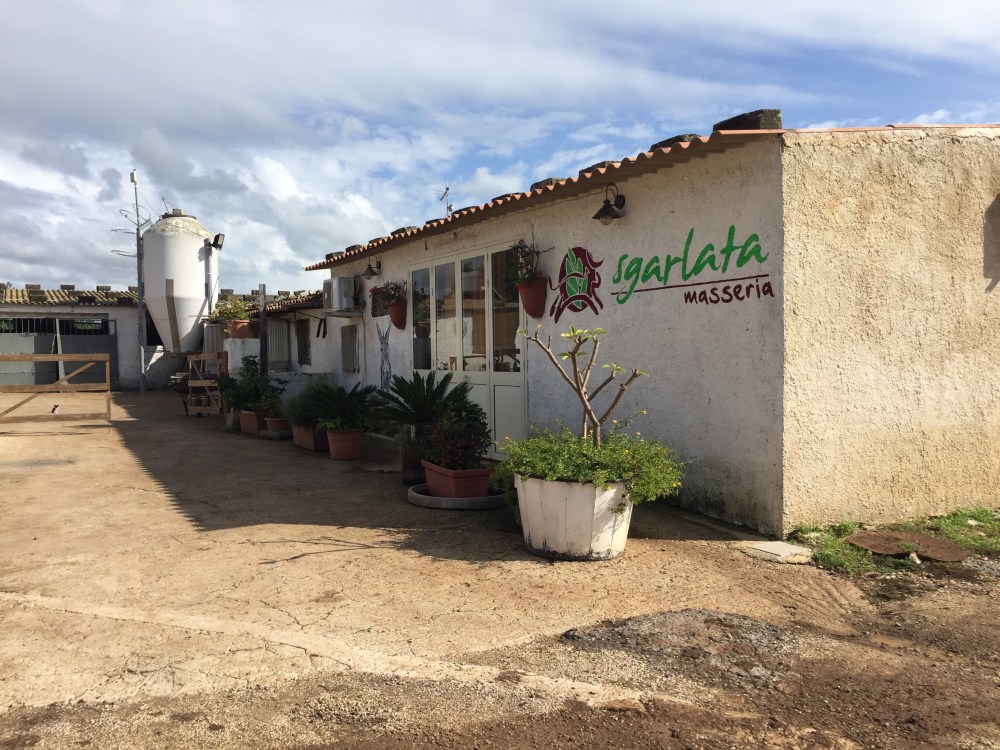
This, among other things, has made Masseria Sgarlata unique, and they frequently receive visitors from all parts of the globe, bringing with them a universal appreciation of cheese and an admiration for the family’s commitment to the art; however, they also bring many different languages, an aspect that has proved challenging when the family tries to share their story.
Hiring a translator is a quick fix, but it’s not the same: the story of your grandparent’s work and passion becomes warped and less genuine when interpreted in the voice of someone else. And it’s this, plus my desire to learn about cheese-making, that brought me to this small town near the southern coast of Sicily.
…
Just a week before, I had no plans for this portion of my trip: I was in Partinico WWOOFing on an olive grove and was filling things in as I went, not wanting to feel constrained by plans I could’ve made back in the US without knowing where things may lead. As had been the trend throughout my 3 months in Italy, it was thanks to a chain of wonderful, extremely helpful people that I found my (semi-last-minute) way to Masseria Sgarlata.
My friend Cristiano, whom I had been connected with in Boston via Slow Food, shared with me the name of a restaurant he thought I might be interested in given its commitment to sustainability and local sourcing, and a necessary stop on one of his tours with his company Food.Stories.Travel.
In planning my visit, I spoke with Roberta, author and co-owner of said restaurant, Il Consiglio di Sicilia, and mentioned my predicament: I had about a week to kill between the northern part of the island and when my aunt would arrive in Catania, and I was looking for a place to stay nearby their area of Donnalucata. After explaining my interests and what I was doing here in a speech in Italian I have memorized word-by-word at this point, she said she had the perfect place in mind.
A few days later, I was speaking to Carmela on the phone and confirming that I would arrive next week. I was ecstatic! I would stay in their guest room and spend the week with them at their masseria (farm), learning about their cheeses in exchange for a little help in the kitchen and some English lessons…because anyone, especially a native speaker, can teach English! I was a little nervous about their expectations for this, as I have had no formal experience teaching English before, but as was a common theme throughout my trip, I went with it.
The consolation that I would be helping them eased my worries: with many visitors coming more and more frequently from England, America, and other English-speaking countries, they had a need for an organized, clear step-by-step process of the discourse they usually give to their Italian guests that would allow them to side-step the use of a translator and share their story themselves.
Back at the dinner table after that day in the latteria seeing the process first-hand, the steps swirled in my head. I felt bursting with information and wanted to know every detail down to the most minuscule, out of pure curiosity but also out of determination to accurately portray what Francesco had so patiently dictated to me. As I’ve learned, you can’t pretend to understand a process without knowing it from the ground up. My notes on my phone where scattered, and I was full with follow-up questions: was a specific type of salt required? What were the different roles of the enzymes he had mentioned? And at what point did this process differ from other cheeses?
With this last question, I was greeted with a little confusion, and it wasn’t because of translation.
Across the table my hosts boldly stated: “La ricotta non e’ un formaggio – e’ un sottoprodotto di latte.”
In English, “Ricotta is not cheese – it is a by-product of milk.”
This wording was interesting to me. The word “by-product” implies that its creation was not intended. According to this phrasing, milk was the main goal, and ricotta was just something that…happened.
It’s funny to think of it in this way, as ricotta is the most popular item they sell at the masseria, and it hardly seems like an after-thought.
But traditionally, that is exactly how ricotta came to be, and when I look at the steps not in the mindset of a consumer but of a farmer who is trying to make the most of what he has, I can understand how ricotta itself exists out of necessity, out of using what you have in abundance down to the very last bit, in the conservation of a raw product, and not letting anything go to waste.
…
Every morning at the masseria begins the same: Francesco heads to the latteria where fresh milk from their cows in the stable next-door is ready to be transformed.
The preparation depends on the day – maybe its caciocavallo or provola this time – but ricotta is always on the list, and orders are tacked onto a bulletin board as calls arrive on a phone that seems to never stop ringing at all times of the day.
Milk is the main star here, and its quality is integral for whatever it will be transformed into. At Masseria Sgarlata, they do not pasteurize their milk – i.e. it is not heated to 70 degrees to sterilize it. They prefer to keep it in its natural state, and complete rigorous, regular testing to make sure it is healthy and safe for consumption by checking its bacterial content every 15 days and monitoring the health of their cows.
The process of making ricotta comes down to its name: ri-cotta, which literally translates to “re-cooked”. To put it simply, milk is heated (1st cooking), and its leftover liquid is then re-cooked (2nd cooking). Voila! Now you know how to make ricotta!
Turns out it’s a little more detailed than that, and it takes years to get the perfect touch. On this day in the latteria Francesco is accompanied by Mario, Carmela’s cousin, who started a few months back and is still learning. “If it turns out bad, it’s because Mario made it; if it’s good, it’s because I made it,” Francesco jokes.
Francesco and Mario explaining how each cheese-maker has their own signature – no cheese is the same! I promise I know how to say more than “Si”…
It’s with this light-hearted tone that we begin, and I’m ready to take notes.
La prima cottura – the first cooking
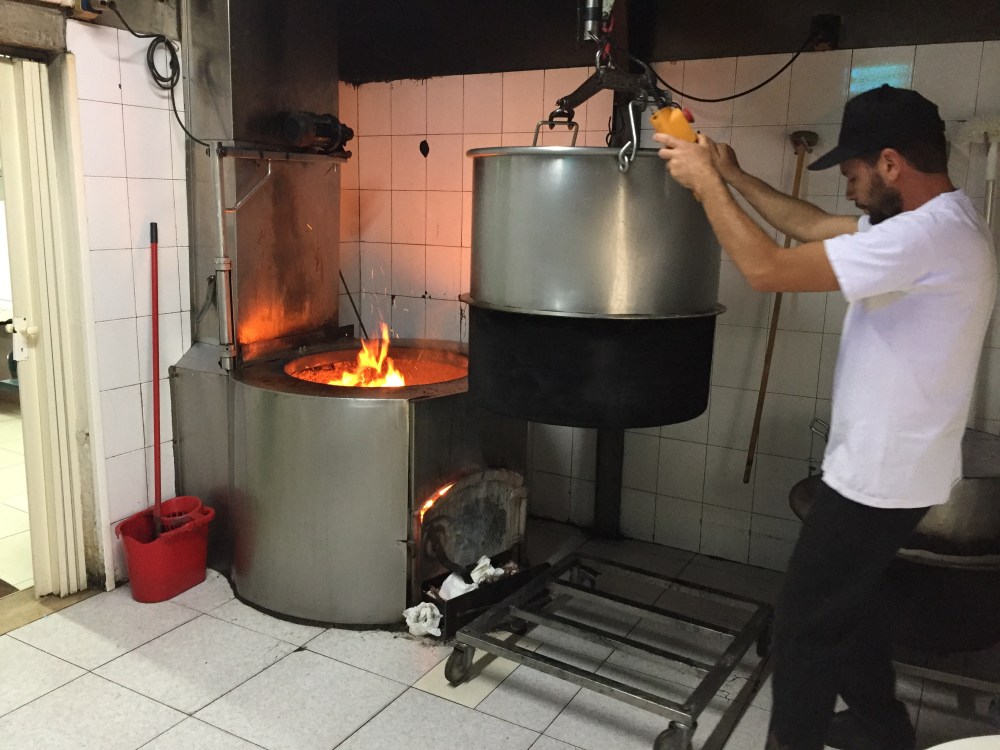 The fresh milk is poured into a large cauldron and heated over a wood-burning stove that is poked, prodded, and fed throughout the process.
For its initial cooking, the milk is heated to 38 degrees Celsius, the same temperature that it naturally comes out of the cow during milking. This temperature is important to activate enzymatic processes and prepare the milk for what is added next: rennet (il caglio).
Rennet is a natural mixture of proteins and enzymes found in the intestine of different mammals, and is necessary for the cheese-making process, although interestingly enough there are vegetarian and vegan options, as a similar compound is also found in the leaves of some plants in the artichoke family.
Regardless of its source, rennet causes milk to curdle, and once added it goes to work for an hour generating the curds. Curd formation is necessary to achieve the proper elasticity and desired structure for a cheese.
Once the curds have formed, they are broken up with a whisk-like tool, and water at 100 degrees Celsius is added. While mixing slowly, the curd precipitates at the bottom.
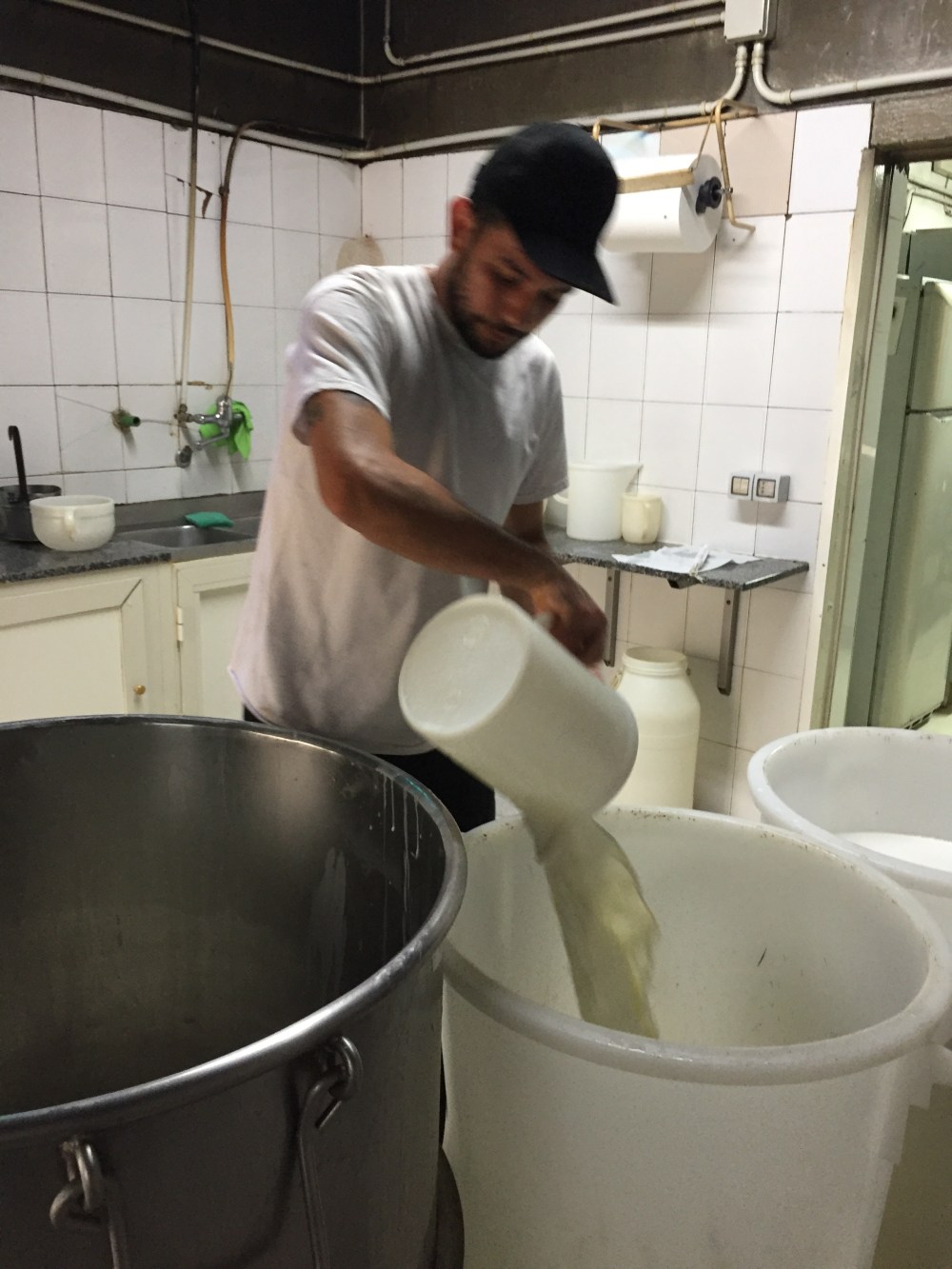
This is the point in the process that becomes specific for ricotta: the first cooking has resulted in two products, a solid (the curd, la tuma), and a liquid (the whey, il siero), that now need to be separated.
The curd is put in a big canister and left to drain. It’s put aside for now, but this curd is extremely important: later on it becomes the starting point for the rest of Masseria Sgarlata’s cheeses.


Ricotta comes from the whey, a cloudy liquid that doesn’t look like it holds much promise for creating much of anything. And it’s exactly this that makes seeing ricotta appear from seemingly nothing so magical.
After filtering the whey to remove any remaining pieces of curd which would disrupt the creamy, smooth texture of the ricotta, it is transferred to a large pot and put on a stove. Now begins the second cooking of the milk.
La seconda cottura – the second cooking
Once over heat, large-grain sea salt is added to the pot, as well as fresh milk. This process is known as “enriching”: it adds fat to the whey that previously left in the form of curd and gives the resulting ricotta more flavor.
The mixture is stirred constantly over heat until it reaches about 86 degrees Celsius, and now we wait. Our heads bent over the bubbling pot being ever so slightly stirred, the suspense builds as we await the first glimpse of ricotta.
Magically, bit by bit, small white flakes slowly bubble to the surface from seemingly nothing. In that humble opaque liquid has occurred a complex series of chemical reactions invisible to the seeing-eye, and with a delicate balance of temperature and a fine hand we now have the first few pieces of one of the most pure transformations of an ingredient.
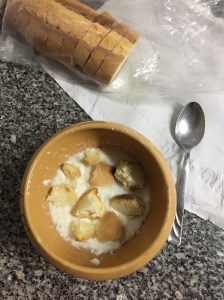
The foam (la schiuma) that has collected on the top is skimmed away, and the moment has finally arrived: my first taste of the freshest ricotta imaginable. A terra-cotta bowl is filled generously to the brim, the ricotta still steaming. I taste it first by itself, and it’s incredibly light – both in flavor and weight – tasting simply of fresh milk. I tear up pieces of bread (Francesco says it’s a must) that soak up the liquid like sponges, and slowly eat spoon after spoon with the warm bowl in my hands. The ricotta is ready, and the pot is removed from the fire.
While I’m happily snacking away, the ricotta is gently collected in slatted-baskets so as not to disturb the fragile structure of the newly-formed product. The vertical openings allow excess liquid to drain, keeping behind only the light and airy ricotta.
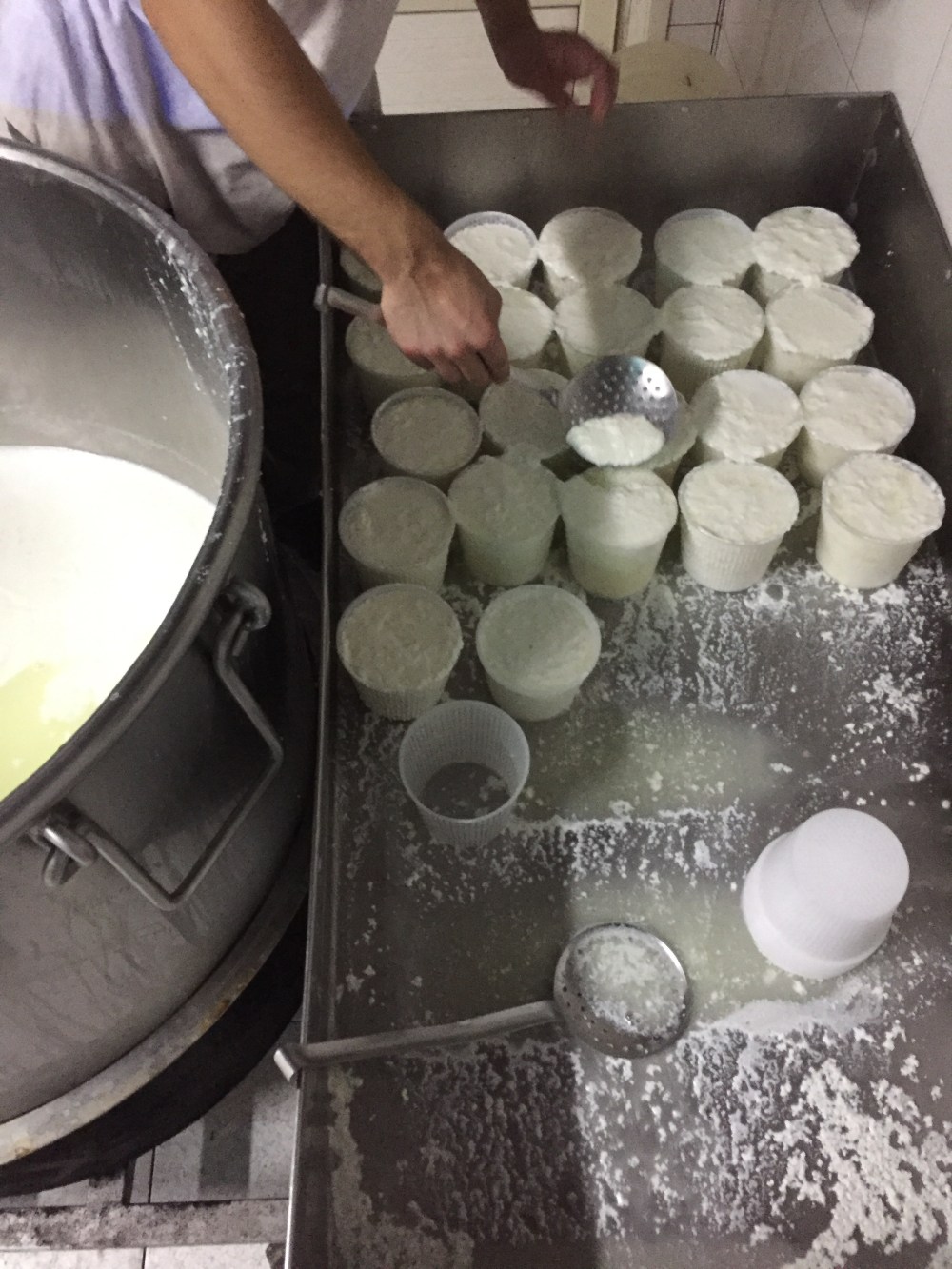
These days, Francesco explains to me, they use plastic baskets out of convenience (which are able to be re-used and recycled), but traditionally ricotta was collected and stored in artisanal bamboo containers known as le cavagne, samples of which are on display throughout their dining room.
One by one, the filled baskets are put in a tub where the liquid (the leftover whey that did not become ricotta) collects in a bucket. This is called il siero scotta – loosely translating to “cooked whey” – and fed to their animals who happily accept the nutritious leftovers. Like all of the bits and pieces of food scraps at Masseria Sgarlata, they find a home with their happy cats, dogs, chickens, and horses.
After all this it seems like the curd from before is the by-product, as it is dealt with only after the starring ricotta is finished, but Masseria Sgarlata makes more than just ricotta.
In the most important step for making the rest of their cheeses, the curd is cooked for around 2 hours to jumpstart the fermentation process. The hot environment is a perfect balance, acting to prevent bad bacteria from flourishing and allowing good bacteria to do their job.
After two hours, the curd is removed and left to dry for up to 24 hours, depending on the season: in the summer, the hot temperature causes fermentation to occur more quickly, i.e. the bacteria convert the lactose in the curd into lactic acid at a faster rate. It takes an expert to know when the appropriate amount of time has passed.
When the curd reaches the right point (usually dictated by its acidity), it is ready to be transformed, and is cut in thin slices in the stacio, a container where it is worked.
Boiling water is added, and a tool known as la manuedda, a stick made of wild olive wood, is used to stretch the cheese. The temperature of this process changes according to the desired cheese.
This process warrants some muscle: the cheese is stretched over the wood, requiring a firm hand but also an intense attention to detail to avoid overworking that would compromise its texture. The obtained product is shaped either by being placed into rigid wooden squares where it is rotated over the course of several days to achieve a uniform block, or shaped by hand into the traditional ball-shape tied with a string and hung over a rod to dry. In fact, this is where the name “caciocavallo” comes from – cacio, meaning cheese, and cavalllo, meaning horse, for when two cheese bundles are strung together and hung over a rod…traditionally carried by horses!

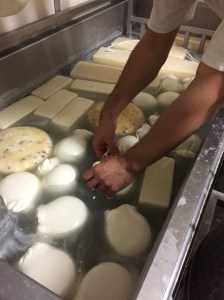
The shapes are then put in a saltwater bath (la salamoia), where they soak for a period of time determined by the dimensions and type of cheese: a half-kilo of provoletta, for example, requires four hours in saltwater, while caciocavallo at fifteen kilo remains submerged for fifteen days in saltwater.
From one simple ingredient – fresh milk – Masseria Sgarlata creates ricotta, tuma, provola, mozzarella, burrata, straciatella…the variations go on. Turns out milk is much more interesting when given a little salt, heat, and time.


…
It’s my last day at the masseria, and it’s also a Sunday, their busiest day of the week.
In addition to making and selling their cheeses, Masseria Sgarlata also hosts le degustazioni (tastings) every Sunday, which can attract up to 40 or 50 people at a time.
The place turns into a restaurant, with a staff of just 4 managing the hustle and bustle: Carmela and her helper, Giusy, shuttle plates of cheese, grilled meats, and salads back and forth from the kitchen, while Francesco and Mario fill the terra-cotta bowls with piping hot ricotta, at the same time keeping up the daily operations of cheese-making in the latteria. I try to be helpful by washing the seemingly endless barrage of dishes, but I don’t know how they do it.
Their days are long, but they still find time to innovate: Carmela thinks of creative ways to spread their message, even hosting groups of hyped-up kids for birthday parties, where education is still the focus, and Francesco experiments with his cheeses by adding local ingredients like wine and fresh oranges.
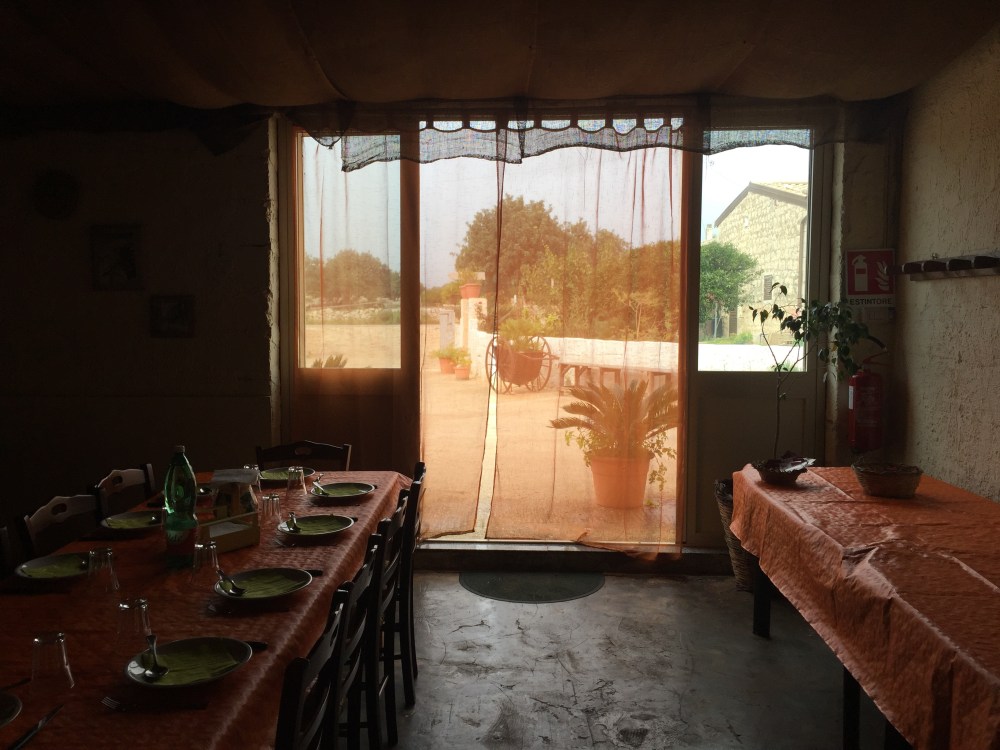
“Non e’ lavoro”, I remember Francesco telling me one of my first days there. It’s not work. It can’t be, he goes on, or else you wouldn’t last: you have to love it. It’s this passion and dedication, coupled with a never-ending work ethic, that keeps them moving forward and passing on their grandfather’s tradition.
It’s time for me to leave – my aunt and her friend are arriving soon in Catania, a short 2 hour drive away – and I don’t want to go. My cheese education was just a small part of my week in Scicli, where Carmela and Francesco gave me a glimpse into their life in this small Sicilian town, from foraging for wild asparagus and rare mushrooms, wandering the quiet church-filled streets at night in search of just one open restaurant, and spending hours at the table talking and laughing about who knows what until midnight (I don’t know when these people sleep). I felt a comfort and sense of welcome I’ve never experienced so far from home, and a way of life I could get quite used to.
My week at Masseria Sgarlata turned into so much more than just “killing a week” between plans. It’s sometimes the most last minute, unexpected things that turn out to be the best.


 Orchard e Orto
Ah, Rachel, beautifully written and I loved reading about the whole process for ricotta. You made it very understandable—even for me! The pictures and videos certainly added to the story. Loving cheese has always made me curious about what goes into cheese production. Thank you!
LikeLike
I’m glad you liked it! You can’t imagine how amazing the room smelled 😍
LikeLike